Towards a Parliament of the living IV – Sun fossilisation
Musée d’art de Joliette, Biophilia, Sept. 30, 2023 -Jan 14, 2024
Curators/Commissaires: Anne-Marie St-Jean Aubre and Marianne Cloutier
Artist.e.s: Zheng Bo, Montserrat Duran Muntadas, Jumana Manna, Katherine Melançon, Joshua Schwebel and Lawrence Paul Yuxweluptun.
ENGLISH
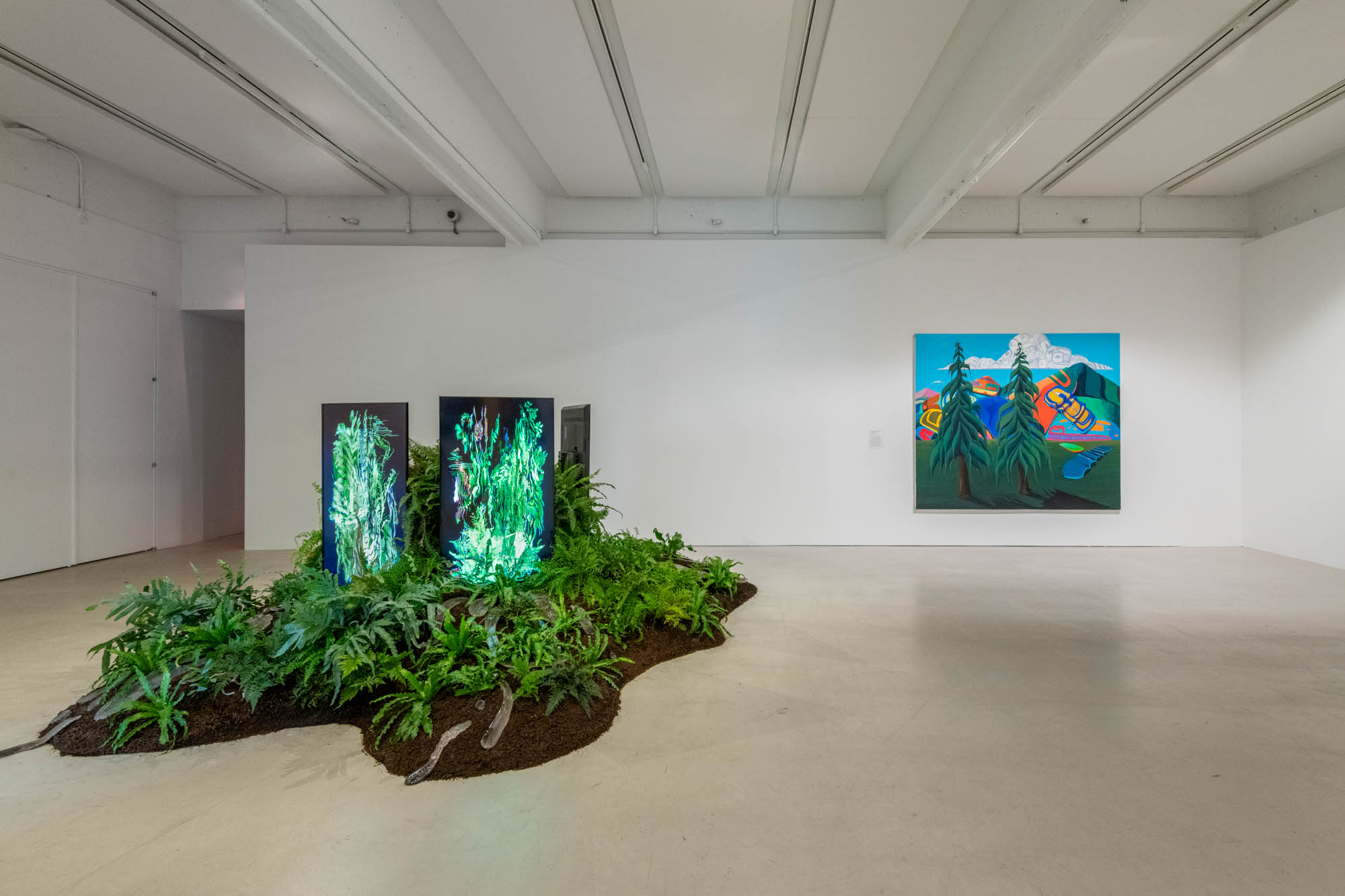
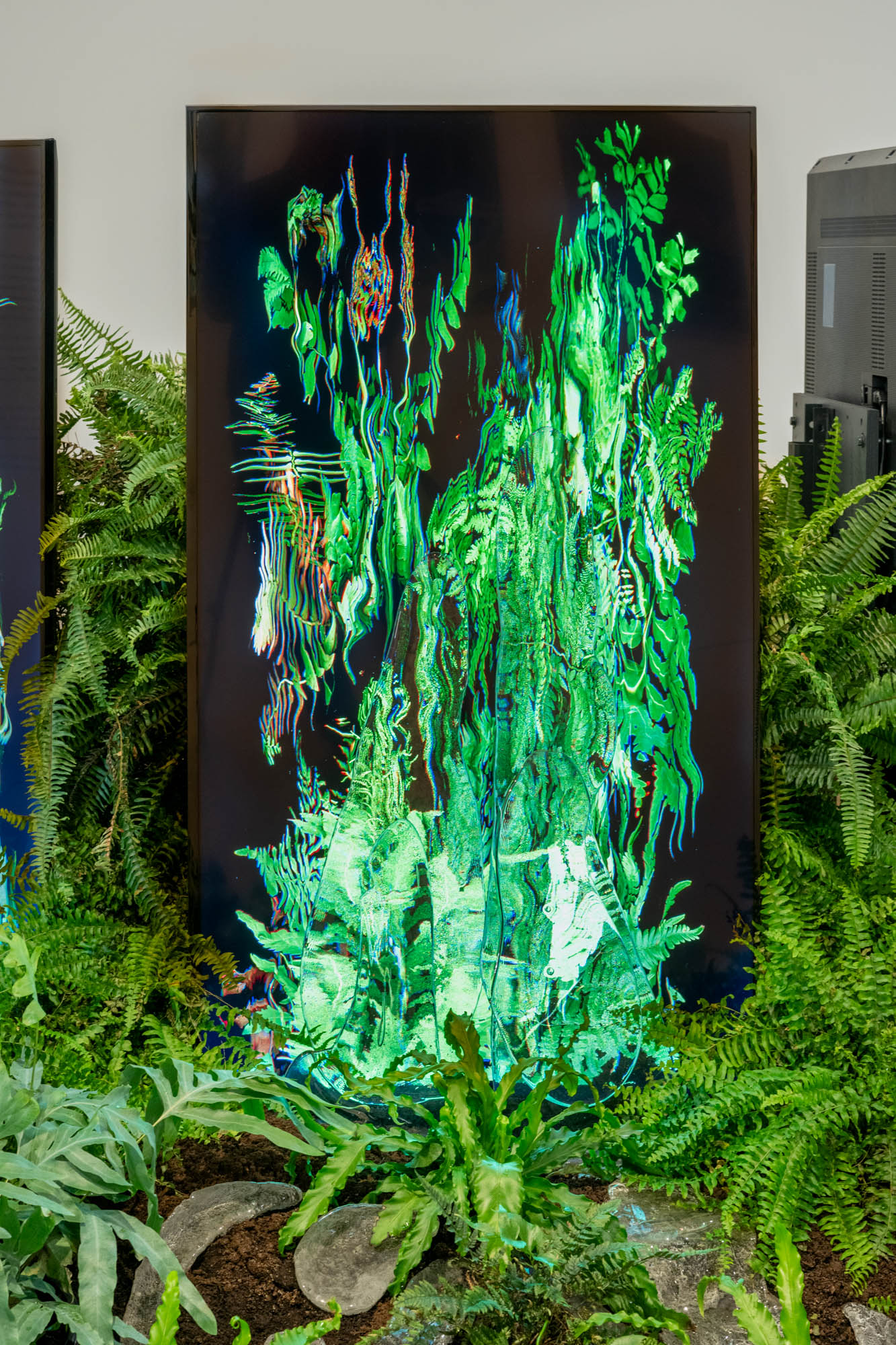
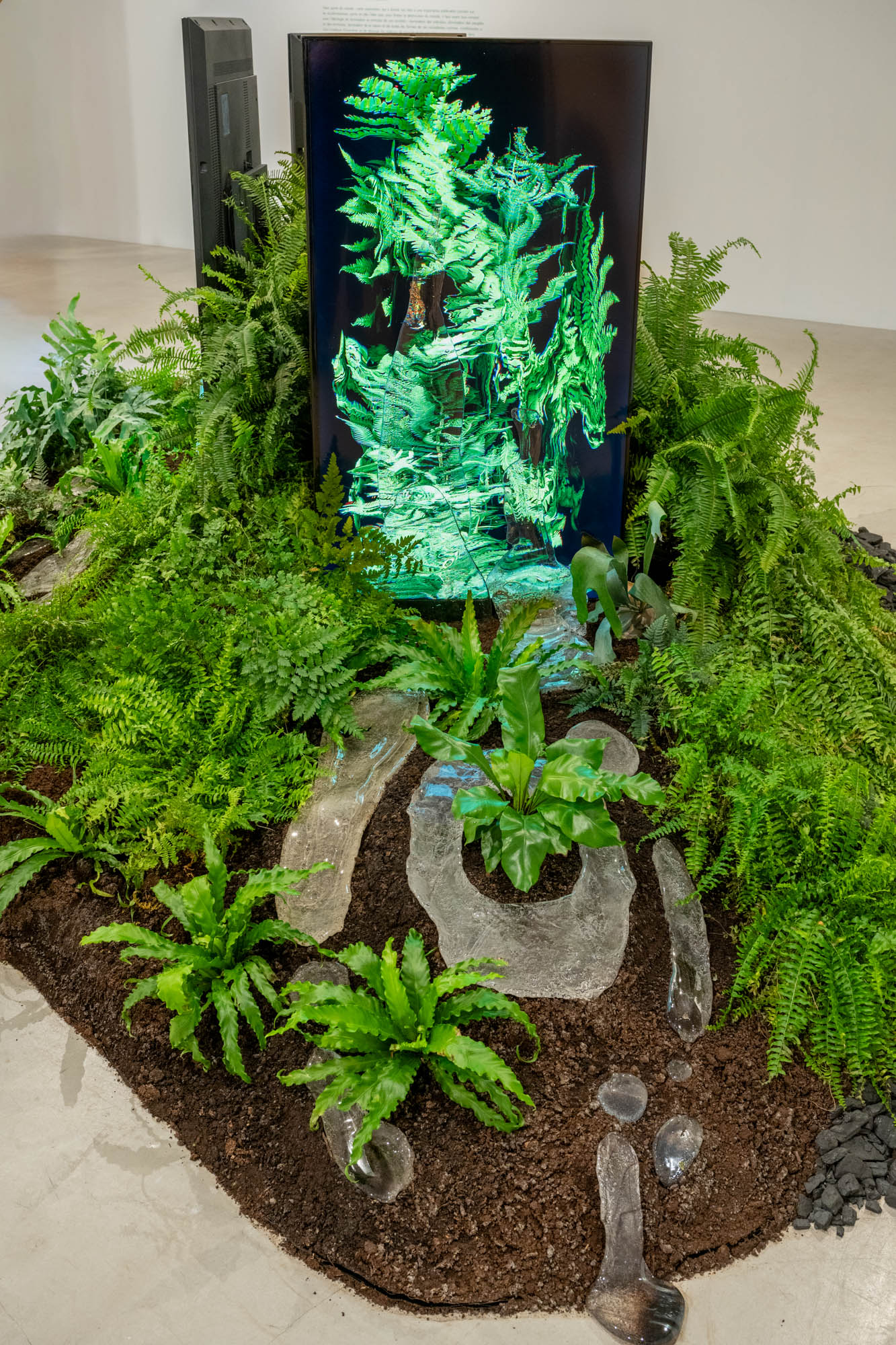
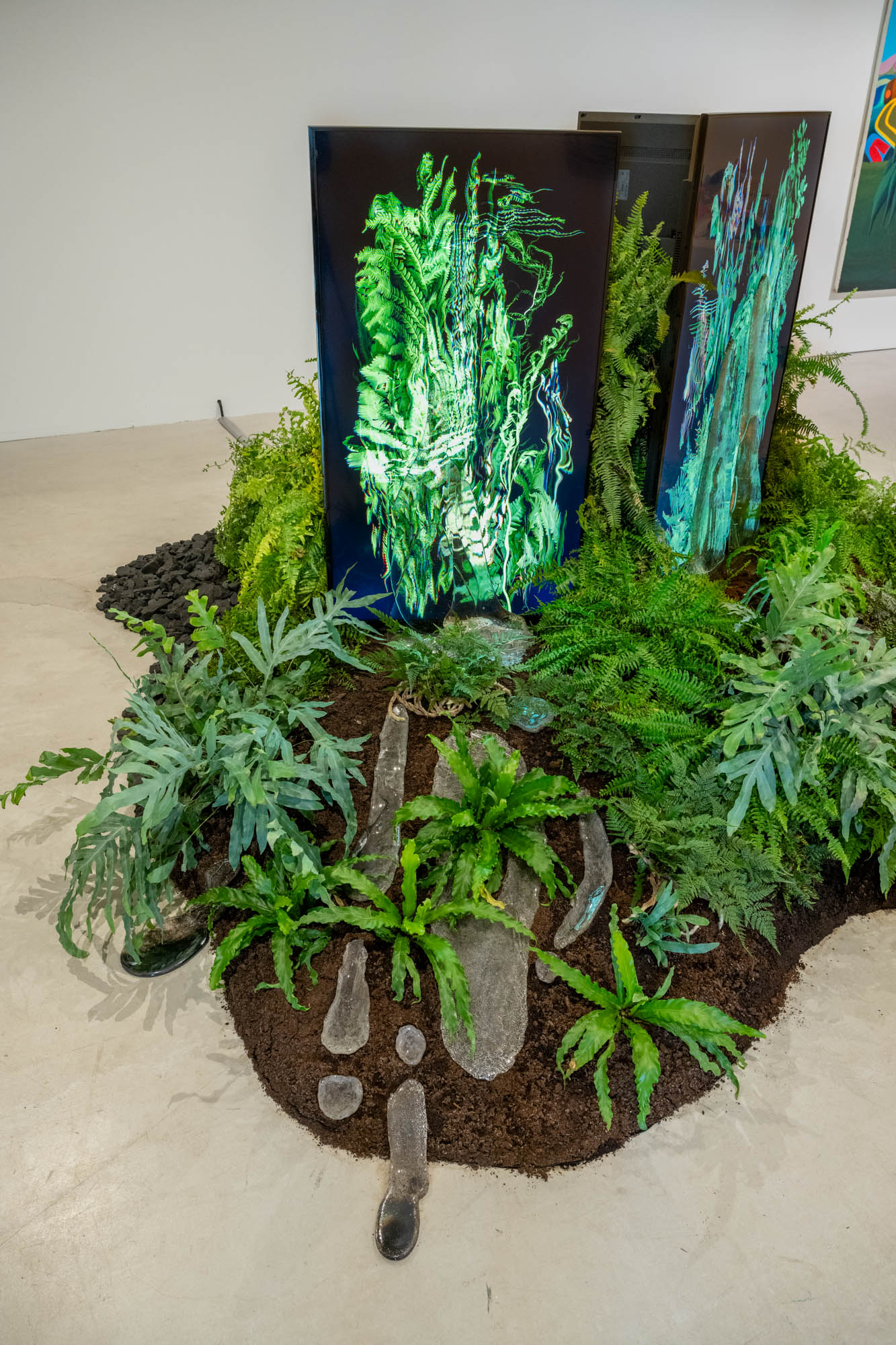
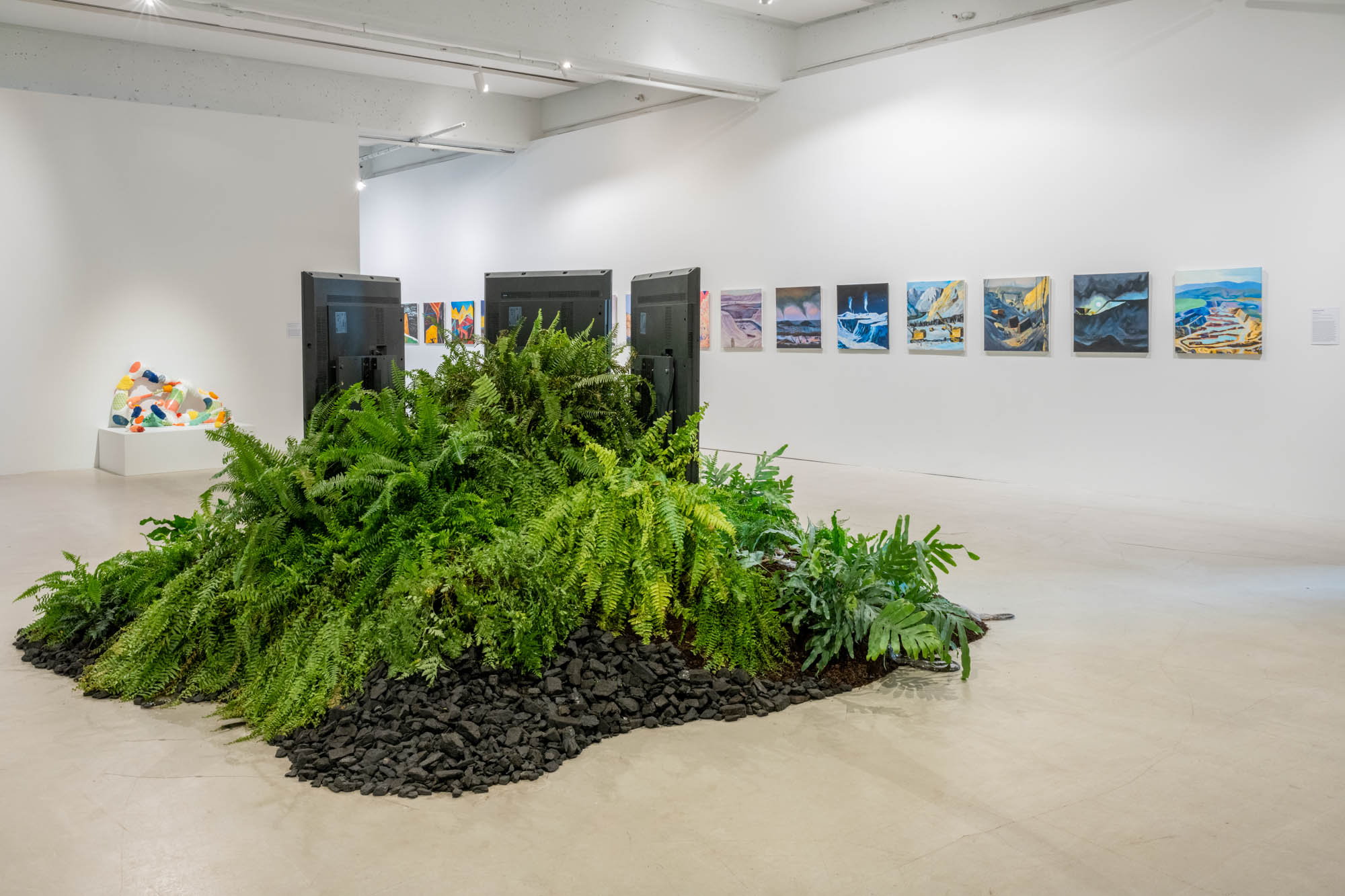
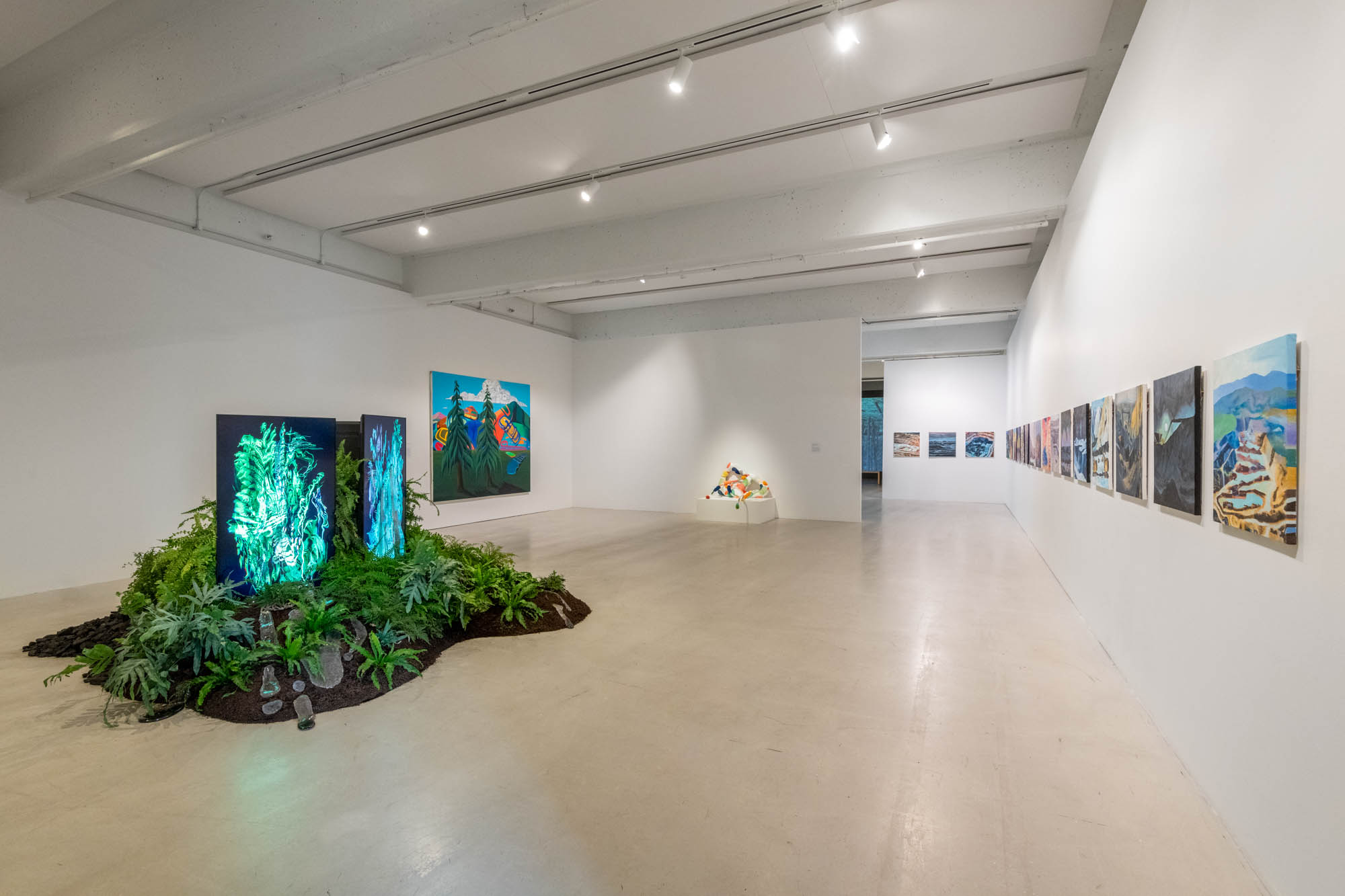
KATHERINE MELANÇON, OSTRICH FERNS, ELECTROMAGNETISM, OUTARAGAWE SIPI (L’ASSOMPTION RIVER), SOIL AND SUN
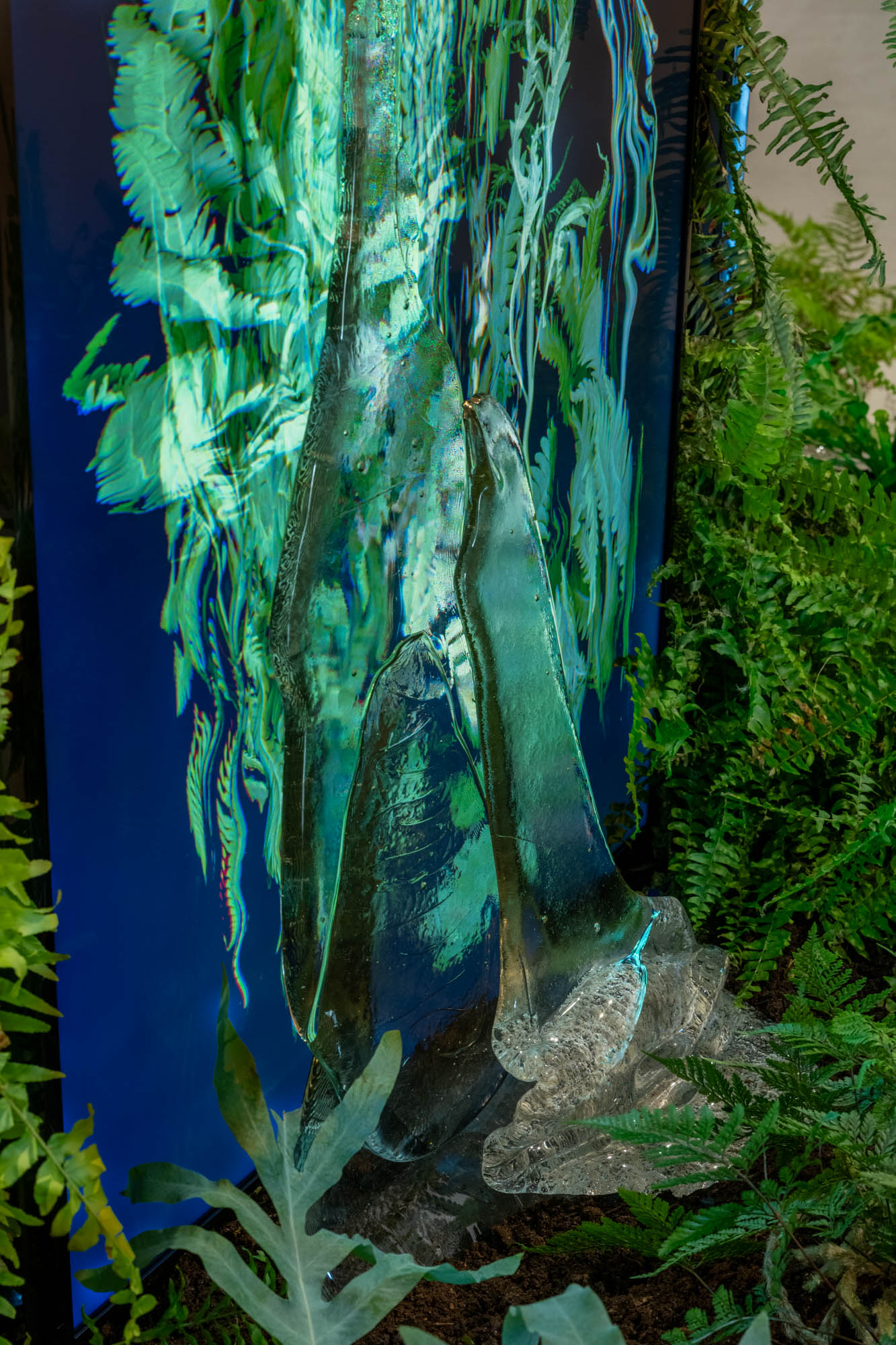
Vers un parlement du vivant IV – Fossilisation du soleil, 2023 [Towards a Parliament of the Living IV – Fossilization of the Sun] Coal (Drummond mine, Nova Scotia), ferns (Common staghorn fern, Bird’s-nest fern, Blue star fern, Boston fern, Japanese Birds Nest Fern, Kimberley queen, Lady fern, Leather leaf fern and Rabbit’s foot fern) monitors, microcontrollers, sensors, Grantham Foundation fern scans (Bracken fern, Christmas fern, Cinnamon Fern, Hay-scented fern, Interrupted fern, Lady fern, Narrow beech fern, Ostrich Fern, Royal fern and Sensitive Fern), visual programming, earth and cast glass, 161 x 364 x 383 cm
In collaboration with Pascale Tétrault (electronics), Denis Le Breton (garden) and Jérémie St-Onge (glass).
The artist thanks Bernard Landriault, Michel Paradis (Fondation Grantham pour l’art et l’environnement) and Ji-Yoon Han, Elektra, Enrique Enriquez and Mario Tremblay, as well as the entire team at the Musée d’art de Joliette.
As if she were giving a voice to the living and staging its narrative, Katherine Melançon focuses here on the history of the fern and its connections with the transformation of human societies. Present on Earth since time immemorial, the fern once thrived under ideal climatic conditions, enabling it to reproduce at a phenomenal rate and intensity. This geological layer, which became coal, powered the industrial era. Towards a Parliament of the Living IV ties this geological history to the history of Joliette and its transformations, from 1850 to the present day, and more specifically to the exploitation and trade of various natural resources. Sensors installed in key locations around the city transmit real-time data of the territory to the installation. The flow of the river and the luminosity captured by the plants, variations in the ph levels of fern-inhabited soils and the edges of the old railway tracks, or the magnetism of the Museum’s digital operations—formerly the site of a public market—dictate the slow movement of the digitized ferns. Melançon thus evokes a past when people lived to the rhythm of the log drive and sawmills, locomotives and coal mines, when life was still considered an exploitable resource. This previous time is superimposed against the city of today and our digital societies, where this concept is no longer feasible. The work thus gives shape to a “thick present”— where past, present and future coexist—a notion borrowed from the Yarralin Indigenous people of northern Australia. Melançon invites us to perceive the living differently, to become aware of its temporality, its agency, and its transformative power. – Marianne Cloutier, curator
FRANÇAIS
KATHERINE MELANÇON, FOUGÈRES À L’AUTRUCHE, ÉLECTROMAGNÉTISME, OUTARAGAWE SIPI (RIVIÈRE L’ASSOMPTION), SOL ET SOLEIL
Vers un parlement du vivant IV – Fossilisation du soleil, 2023 Charbon (mine de Drummond, Nouvelle-Écosse), fougères (Athyrium fougère femelle, Fougère à feuille de cuir, Fougère de Boston, Fougère corne de cerf, Fougère nid d’oiseau Antiquum, Fougère capillaire, Fougère nid d’oiseau commune, Fougère Kimberley, Fougère pattes de lapin, Polypode doré), moniteurs, microcontrôleurs, senseurs, scanographie de fougères de la Fondation Grantham (Fougère à l’autruche, Athyrie fougère-femelle, Dennstaedtie, Fougère-aigle commune, Onoclée sensible, Osmonde Cannelle, Osmonde de Clayton, Polystic faux acrostic, Royale, Thélyptère fougère-du-hêtre), programmation visuelle, terre et verre coulé, 161 x 364 x 383 cm
Réalisée en collaboration avec Pascale Tétrault (électronique), Denis Le Breton (jardin) et Jérémie St-Onge (verre).
L’artiste remercie Bernard Landriault, Michel Paradis (Fondation Grantham pour l’art et l’environnement) et Ji-Yoon Han, Elektra, Enrique Enriquez et Mario Tremblay ainsi que toute l’équipe du Musée d’art de Joliette.
Merci au Conseil des arts et des lettres du Québec pour le soutien financier.
Comme si elle donnait la parole au vivant et qu’elle mettait en scène son récit, Katherine Melançon s’intéresse ici à l’histoire de la fougère, ainsi qu’à ses liens avec la transformation des sociétés humaines. Présente sur terre depuis des temps immémoriaux, elle a jadis connu des conditions climatiques idéales qui lui ont permis de se reproduire à un rythme et une intensité phénoménale. Cette couche géologique, devenue charbon, fut le moteur de l’ère industrielle. Vers un parlement du vivant IV relie cette histoire géologique à l’histoire de Joliette et de ses transformations, de 1850 à nos jours, plus spécifiquement à l’exploitation et au commerce des différentes ressources naturelles. Grâce à des senseurs installés en des lieux significatifs de la ville, des relevés du territoire sont transmis en temps réel à l’œuvre. Le flux de la rivière et le degré de luminosité captés par les végétaux, les variations de ph des sols habités de fougères et des abords des rails de l’ancien chemin de fer, ou encore le magnétisme des transactions numériques du Musée – auparavant le site d’un marché public –, dictent le lent mouvement des fougères numérisées. Melançon évoque ainsi un passé où les gens vivaient au rythme de la drave et des moulins à scie, des locomotives et des mines de charbon, où le vivant était encore considéré comme une ressource exploitable. À ce temps d’avant se superposent la ville d’aujourd’hui et nos sociétés numériques, où cette conception n’est plus possible. L’œuvre donne ainsi forme à un « présent épais » – où cohabitent le passé, le présent et le futur – notion empruntée au peuple autochtone Yarralin du nord de l’Australie. Elle invite à percevoir le vivant autrement, à prendre conscience de sa temporalité, de son agentivité et de son pouvoir de transformation. – Marianne Cloutier, commissaire
Other artworks:

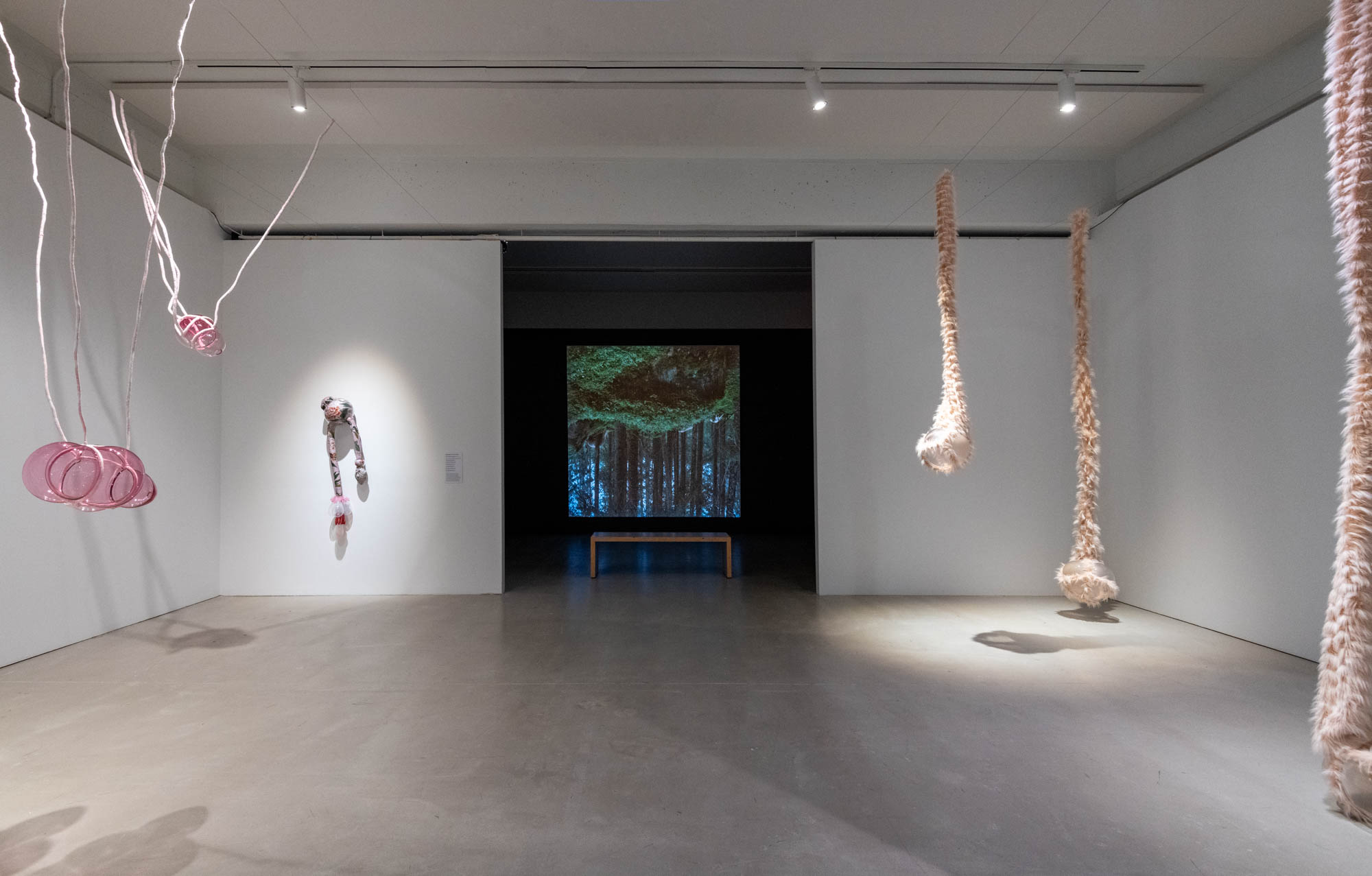
Plus d’information sur chaque oeuvre de l’exposition Biophilia ici (FR)
More information on each artwork in the exhibition here (ANG)
ENGLISH
BIOPHILIA
The climate crisis, whose effects we must deal with every day, is forcing us more than ever to question our individual and collective behaviour. While we certainly need to adjust our lifestyles, we must also rethink our way of being part of the world. This is precisely what the works assembled in this exhibition invite us to do. To be part of the world: this expression, which is also the title of an important book on ecofeminism [Faire partie du monde : réflexions écoféministes], supports the notion that to stop destroying the planet, we must first break the ideology of domination underlying our societies: domination over individuals, domination over people and territories, domination over nature and what we consider “inferior” forms of life. This involves examining and undoing the power relations and inequalities that arise when it comes to environmental issues. Because although we all, to varying degrees, have a role to play in this, our ability to act in the context of this crisis is far from equal. The works presented here explore the ways in which we come in contact with nature from the specific angle of desire, with all of its ambivalence and contradictions. How do we reconcile our yearning to know and discover, to grow and enrich ourselves and our quest for ever-increasing physical and material comforts, with the restraint that, from now on, must be at the centre of our concerns? How can we undo the complex entanglement of land and resource exploitation and appropriation our post-industrial and post-colonial societies still rely on? These works address the limits of regeneration and fertility, but also the intrinsic strength of living beings and their transformative capabilities. Biophilia means “love of nature.” It’s our innate attraction, our human desire to be in touch with living things and to bond with nature. This term sets the tone for the exhibition and encourages respect and kindness towards all forms of life—microscopic organisms, plants, and animals—and every element of nature. It also marks a paradigm shift from the concept of a nourishing Mother Earth—whose resources we exploit—to a loving Earth that we unite with, care for, and love, but don’t seek to possess. Biophilia offers a truly spiritual and sensual communion with nature that goes well beyond our gaze; it’s a union with our entire being. It means beating to the rhythm of nature, to permeate ourselves with it. To introduce ourselves to the forest. To smell the leaves on the trees, caress the moss, feel the flow of a stream on our skin. To feel the substances that shape our environments by and through our bodies, to sense that we form a whole—that we are nature.
Marianne Cloutier, Interim Curator of Contemporary Art
Anne-Marie St-Jean-Aubre, Guest Curator
FRENCH
BIOPHILIA
La crise climatique, dont nous subissons chaque jour les effets, nous force plus que jamais à interroger nos comportements individuels et collectifs. Si nos modes de vie doivent sans conteste s’adapter, ce sont aussi, et avant tout, nos manières de faire partie du monde qu’il faut repenser. C’est ce à quoi nous invitent les œuvres rassemblées dans cette exposition.
Faire partie du monde : cette expression, qui a donné son titre à une importante publication portant sur les écoféminismes, porte en elle l’idée que, pour freiner la destruction du monde, il faut avant tout rompre avec l’idéologie de domination au principe de nos sociétés : domination des individus, domination des peuples et des territoires, domination de la nature et de toutes les formes de vie considérées comme « inférieures ». Ceci implique d’examiner et de dénouer les relations de pouvoir et les inégalités qui entrent en jeu dans les questions environnementales. Car, bien que nous ayons tous et toutes, à des niveaux différents, un certain rôle à y jouer, notre capacité à agir dans le contexte de cette crise est loin d’être égale.
Les œuvres réunies ici explorent nos manières d’entrer en contact avec la nature sous l’angle particulier du désir, de son ambivalence et de ses contradictions. Comment réconcilier nos désirs de connaître et de découvrir, de croître et de s’enrichir, la recherche d’un confort physique et matériel toujours plus grand, avec la sobriété qui devra désormais être au cœur de nos préoccupations? Comment défaire l’écheveau complexe des dynamiques d’exploitation et d’appropriation des terres et des ressources, sur lesquelles reposent toujours nos sociétés post-industrielles et post-coloniales? Les œuvres présentées abordent les limites de la régénération et de la fertilité, mais aussi la force intrinsèque du vivant et ses capacités de transformation.
La biophilie signifie « l’amour du vivant ». C’est notre attirance innée, notre désir humain d’entrer en contact avec le vivant et de nouer des liens avec la nature. Ce terme, qui donne le ton à l’exposition, invite au respect et à une forme de bienveillance envers toute forme de vie – êtres microscopiques, plantes et animaux – et envers tout élément de la nature. Il marque également un changement de paradigme, le passage d’une conception de la Terre-mère nourricière – dont on exploite les ressources – à une Terre amante, à laquelle on s’unit et dont on prend soin, que l’on aime, mais que l’on ne cherche pas à posséder.
Biophilia propose une véritable communion spirituelle et sensuelle avec la nature, qui va bien au-delà du regard, une union du corps entier. Battre au rythme de la nature, nous en imprégner. S’introduire dans la forêt. Sentir les feuilles des arbres, la caresse des mousses, le flot du ruisseau sur sa peau. Sentir la matière qui forme nos environnements par et à travers nos corps, sentir que nous formons un tout – que nous sommes la nature.
Commissaires : Marianne Cloutier et Anne-Marie St-Jean Aubre
Vues de l’exposition Biophilia, Musée d’art de Joliette, 2023 – Photo : Paul Litherland
 Katherine Melançon